























History

Echoes of the Old Country: Growing Up German-Russian on the Northern Plains
Unique in its topic and methodology, Echoes of the Old Country reveals purpose and power in childhood memory for the Germans from Russia who survived and prospered on the northern Great Plains. Historian Jessica Clark’s study draws on nearly two hundred oral interviews collected during the Dakota Memories Oral History Project, conducted from 2005 to 2010. Clark and a team of oral historians and videographers recorded the voices and memories of participants as they responded to various memory prompts—browsing scrapbooks and diaries or walking through towns and cemeteries where familiar storefronts and headstones stirred vivid recollections. No history of childhood draws from such a rich oral history source. Clark reveals that second-and third-generation German-Russians adhered to a collective identity rooted in the struggles and hardships experienced by their immigrant forebears. Yet, they simultaneously forged a new identity—one that found sport in chores and responsibilities and joy in pranks and play. Their evolving self-image contrasts with narratives of toil and deprivation often associated with growing up in rural and agricultural environments.

History & Memory in German-Russian Country
The Germans from Russia—an agricultural people who settled, survived, and prospered—formed strong ethnic communities where farmers still plant and harvest, the faithful still gather for worship, and the cooks still feed their families from the garden. This is a story of German-Russian persistence on the northern plains and its emergent consciousness—a sort of heritage husbandry—in the late twentieth century.

Tough but Fair
“Tough but Fair originated from my twenty-eight years of experience working with troubled juveniles and convicted felons. On December 1, 1972, I was appointed Deputy Warden of the North Dakota State Penitentiary. The prison was on the verge of being out of control daily…inadequately funded and staffed by untrained, aging correctional officers; uneducated managerial staff; and one qualified social worker. The combination of these factors led to assaults on staff, improper discipline, a rapid decline in the facility structure, and extreme disrepair of the utilities and services. A new warden was appointed, and he began to organize a plan to regain control of the inmate population, institute programs that would divert the inmates away from criminal behavior within the prison, and build respect for the staff. These challenges led me on a journey that was intellectually, physically, and spiritually transformative. It was the greatest challenge of my life.” - Winston E. Satran
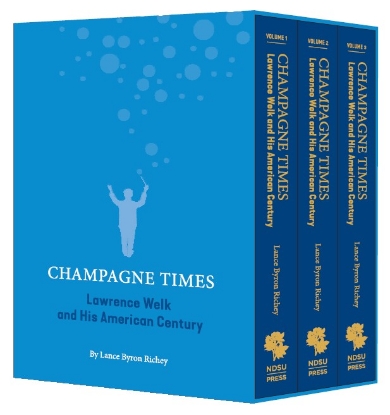
Champagne Times: Lawrence Welk and His American Century
Over seventy years after his debut on KTLA in Los Angeles, and nearly decades after his debut on ABC in 1955, Lawrence Welk's unprecedented and almost continuous run on network, syndicated, and now public television confirms his place in American entertainment history. From his childhood in a small, German-speaking immigrant community on the North Dakota plains to one of the richest and most recognizable entertainers of his generation, Lawrence's story is a microcosm of the national experience during the American Century.
By telling his story, author Lance Byron Richey came to understand the experience of assimilation and secularization, war and peace, and Depression and prosperity that his generation of Americans lived through in the twentieth century. In the process, the supposedly traditional and timeless values Lawrence mythologized for his audience were revealed as just as time-bound and transient as those of the Baby Boomer generation that supplanted him and his generation as the arbiters of cultural taste.
Most importantly, though, as a man, Richey came to see Lawrence in his moral simplicity and personal complexity, a deeply good and decent man whose family often paid the price for his unquenchable desire for success and security, which his childhood on a North Dakota farm had implanted in him. In short, Welk's story is a quintessentially American story.
The first edition of Champagne Times is limited to five hundred numbered copies, all of which have been signed by the author. The book covers are SKIVERTEX Vellin #5517 blue casing, premium grade, simulated leather material debossed with gold foil. They are designed by Deb Tanner; printed and bound by Thomson Reuters Core Publishing Solutions.
Lance Byron Richey serves as President of the University of Saint Francis in Fort Wayne, Indiana, where he also holds the rank of Professor of Theology. A graduate of Furman University (B.A. in History, 1988) and Conception Seminary College (Certificate of Pre-Theological Studies, 1991), he studied both Philosophy (PhD 1995) and Religious Studies (PhD, 2004) at Marquette University i Milwaukee, Wisconsin; he as published widely in both disciplines. Lance and his wife, Carol, have five children.
LCCN: 2025938196
ISBN: 978-1-946163-76-9
Volume 1: Fire in the Belly (1903-1945), 400 pp., 37 b&w photos
Volume 2: Evening Star (1945-1963), 416 pp., 39 b&w photos
Volume 3: A Rock in the Storm (1964-1992), 424 pp. including 16 color photo pp., 36 b&w photos
Hardcover, packed in slip-case, limited edition, signed and numbered
Publication Year: 2025
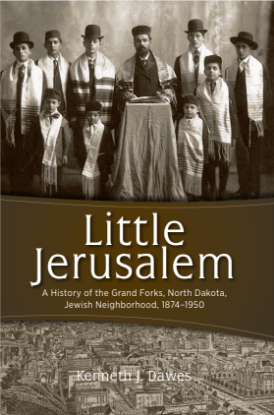
Little Jerusalem: A History of the Grand Forks, North Dakota, Jewish Neighborhood, 1874-1950
In Little Jerusalem, Kenneth J. Dawes relays a thorough exploration of the history of Jewish people in rural North Dakota, emphasizing the Papermaster family and the rabbis who served in the Grand Forks area. Dawes creates an image of the Jewish community as resilient and inspiring in spite of challenges of adjusting to life in rural North Dakota.
As a newspaper boy growing up in Little Jerusalem, Kenneth J. Dawes met and grew to appreciate his Jewish neighbors while delivering the news and collecting weekly subscription fees of thirty-five cents. In Little Jerusalem, Dawes—now a retired academic—revisits his childhood neighborhood from a scholar’s perspective. Little Jerusalem is a thorough exploration of the history of Jewish people in rural North Dakota with an emphasis on the Papermaster family and the rabbis who served in Grand Forks. Dawes delivers an image of the community members as resilient and inspiring first- and second-generation Jews on the northern plains. Little Jerusalem reveals the history of largely unknown Jewish pioneers who helped shape the city of Grand Forks from 1874 through 1950.
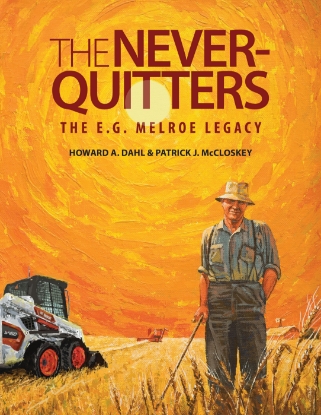
Never-Quitters: The E.G. Melroe Legacy, The
by Howard A. Dahl & Patrick J. McCloskey
They built. They failed. They risked everything. And they kept going.
The story begins in nineteenth century Norway, where violence and fraud propel a family toward a better life in America. It reaches the North Dakota prairie, where E.G. Melroe's first invention arrives on the eve of an agricultural depression. What follows is no smooth march to success. Companies hang by a thread. Credit tightens. Machines break. Family and faith are tested. At each turning point, the Melroe and Dahl families must decide whether to retreat--or bet again on an idea, their employees, and one another.
In The Never-Quitters, you'll find the previously "untold story of the Melroe Company, the birth of the Bobcat loader, the rise of Steiger Tractor, and the development of the Concord air seeder and Amity International."
--Heidi Hietkamp, former U.S. Senator